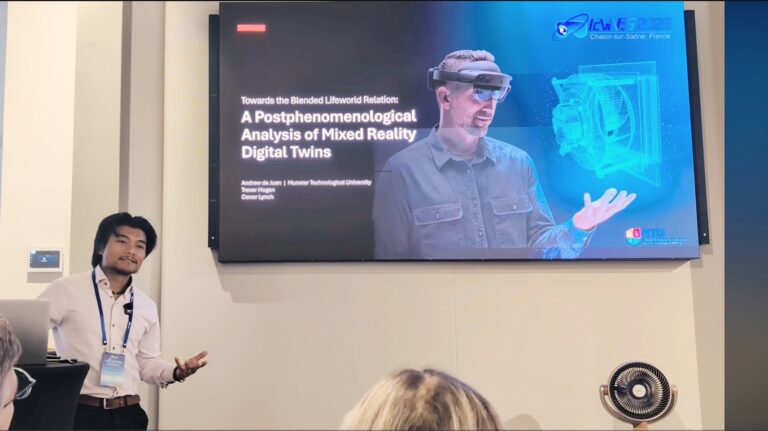
What are my key objectives?

For my PhD full proposal, it is important that I understand what my overarching goals are and subsequently the objectives that underpin the primary objective.

The overarching objective of this research is to develop a comprehensive postphenomenological understanding of the lived experiences of users interacting with dynamic MRDTs, specifically analysing how this technology mediates their perception, action, and understanding within a hybrid physical-digital environment. By properly applying this postphenomenological framework, a robust research plan will be designed and configured as outlined in this proposal in order to extract and articulate first-person perspective accounts through appropriate and effective data collection methods. Achieving this will establish the core phenomenological data (the “what” and the “how” of experience), which will be the basis for all the potential outputs of the in-depth analysis.

The primary objective of the research project is contingent upon achieving the following supporting objectives:

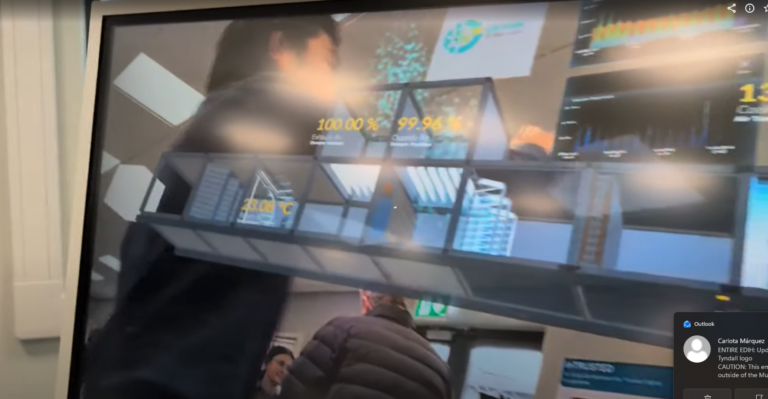
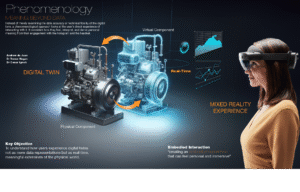
  1. To design, construct, and implement a functional MRDT system, comprising a physical component (e.g. smart cube) equipped with sensors and a custom-developed HoloLens 2 application for real-time holographic visualisation and bi-directional interaction. This would be the reduced form and representative of an asset twin, which will establish the specific technological system that will serve as the phenomenon to be observed in this study.
  2. To analyse how Don Ihde’s human-technology relations (embodiment, hermeneutic, alterity, and background) manifest in user interactions with MRDTs, and how these relations shape their experience of agency, presence, and connection. This is the core theoretical framework that will be used to interpret the lived experiences of the selected participants.
  3. To identify essential themes and structures in user accounts of MRDT interaction, revealing the perceptual transformations and shifts in sense-making facilitated by the technology. This will be the in-depth analysis of the data collected. The bulk of the novel contribution is envisaged to arise from the synthesis and deeper analysis of the data.
  4. To develop a set of design considerations, informed by phenomenological analysis, that foster user-centred MRDT interfaces. This represents a potential offshoot of the research findings. From the perspective of MR application development, these insights could highlight new avenues for improving user interface (UI) design, as user experience (UX) will be thoroughly explored.
  5. To disseminate the findings through peer-reviewed publications and presentations, contributing to the fields of HCI and the philosophy of technology. This is the output objective, which is highly dependent on the successful completion and analysis of all preceding objectives.

The application of this postphenomenological framework to the interaction with this particular technology is to achieve the overall objective of gaining a deeper and nuanced understanding of the lived experience of users interacting with MRDTs. This will be a phenomenological inquiry informed by Don Ihde’s postphenomenology and his framework of Human-Technology Relations (HTR). The impact and contribution will advance the nuanced current understanding of the postphenomenology of MRDTs as a novel technological context in the ICT and HCI fields.

Justifiying my Methodology

Assignment submission due (Research Strategies Module)

There is a submission on May 6th for the module, Research Strategies, which I am currently working on. The assignment requirement is to provide my critical justification for my chosen methodology in framing and executing my research. What is the most suitable approach, and why is it appropriate for addressing the research question(s) that I have laid out for myself? This assignment question has forced me to dwell on my proposed methodology, but inevitably solidify and validate some of the methods that I have chosen. It also constantly reminded me to defend and critically analyse the methods, and not just to simply state that they align. I had to argue how it does and also discuss the limitations and the various trade-offs of prioritising one over the other.

Research Ethics Application Form

Completing this form is an absolutely necessary requirement given that my methodology is going to be fully qualitative, meaning that humans and human data are going to be involved.

So what I’ve done is simply looked at the Minimal Risk Human Research Ethics Application Form. I have not delved into what sort of forms the data collection/gathering will take. Although I am pretty confident that a semi-structured interview will be one to include.

I will also need to have a robust data management plan for sure, as I will be, in some form, storing the data digitally (i.e. text documents, audio & video recordings). I can complete some fields of the form for starters, but for meto properly complete it, I would need my research design ironed out and my literature review completed.

Short-term goals

Up until September, I should have some clarity on what I am doing more so than before.  So my hit targets are:

  1. Literature review and proposal development   
  2. Ethics approval
  3. Initial MRDT system setup

Breakdown of Time Allocation (Approximate and extremely ambitious):

Year 1:

  • Literature review and proposal development    
  • Ethics approval
  • Initial MRDT system setup – I’m greatly underestimating this technical development project 

Year 2:

  • Pilot study and refinement
  • Participant recruitment
  • Data collection (substantial portion)    
  • Initial data transcription and analysis

Year 3:

  • Intensive data analysis (IPA or thematic analysis)
  • Connecting findings to Ihde’s framework    
  • Drafting methodology and findings chapters

Year 4:

  • Completing thesis draft
  • Seeking feedback and revisions

Year 5:

  • Final thesis revisions and submission
  • Viva voce examination preparation and defense

We shall see how I get on. These simple lines entail hours of thinking, designing and developing.

More Postphenomenology stuff

Core Concepts and Principles

Ihde’s postphenomenology marks a significant shift in the philosophy of technology, moving away from considering technology as a set of isolated objects to focusing on the dynamic and complex relationships between humans and technology. A prominent characteristic of postphenomenology, which makes it fully contemporary, is its inclusion of technoscience studies. Ihde strongly advocates for what is known as the empirical turn in the philosophy of technology, arguing that we need to move away from abstract generalisations about “technology” and instead concentrate on concrete technologies and their specific roles in our lives (Ritter, 2024). Central to Ihde’s framework is the concept of technological mediation, which posits that technologies are not neutral tools but actively mediate or shape our experience of the world. As Ihde argues, technologies influence our perception, action, and understanding, challenging the notion of technological neutrality (Ihde, 1990). Ihde challenges the idea that technology is simply a tool that we use objectively, arguing that technologies possess a form of “intentionality” and affect our experience in ways that we may not fully realise. To properly investigate these influences, Ihde emphasises the importance of empirical investigation, advocating for the study of actual technology-user interactions (Ihde, 1993); this emphasis justifies the use of qualitative methods like interviews and observation to gather rich data on user experiences with MRDTs.  

Ihde’s Human-Technology Relations (This may be the crux of my analysis)

Ihde’s framework includes specific categories of human-technology relations, which are crucial for this analysis (Ihde, 1990). First, embodiment relations occur when technology becomes an extension of the human body or senses (Ihde, 1990). In the context of MRDTs, this can be seen in how the MR display might function as an extension of the user’s visual perception (Ihde, 1990, p. 72), or how interacting with the smart cube (the main object/tool for the phenomenon – currently at the conceptual stage) and receiving holographic feedback might extend the user’s sense of touch or manipulation. Second, hermeneutic relations describe situations where technology serves as a tool for interpreting the world (Ihde, 1990). With MRDTs, the holographic visualisations of data act as a “technology-world” representation that users must interpret to understand the real-world entity they mirror (Ihde, 1990, p. 83). Third, alterity relations emerge when technology is experienced as “other,” almost as having its own agency (Ihde, 1990). In MRDT interaction, it is important to examine if users perceive the holographic representations as having a degree of autonomy or “otherness,” particularly in how they respond to the sensor data (Ihde, 1990). Finally, background relations refer to how technology forms the environment or context of experience, often unnoticed (Ihde, 1990). This is relevant to consider how the MR environment itself, including the display and tracking, shapes the user’s overall experience, even if their focus is on the smart cube and its corresponding hologram.  

Key Concepts to Apply

Several key concepts from Ihde’s work are crucial to apply in this study. The concept of mediation, central to Ihde’s thought, goes beyond simply “going between”; it involves technology actively shaping our experience (Verbeek, 2005). In the context of MRDTs, it is essential to analyse how the MRDT shapes the user’s experience of the smart cube, the data, and the interaction itself. Furthermore, Ihde argues that technology alters our perception, leading to perceptual transformations (Ihde, 1990). This study will explore how the MRDT changes how users perceive the physical cube, the sensor data, and their own interaction within the hybrid environment. Finally, Ihde emphasises the role of embodiment in our experience of technology (Ihde, 1993). Therefore, it is important to analyse how the user’s embodied interaction, including hand movements and vision, shapes their experience of the MRDT.  

Critical Awareness

Throughout this study, it is essential to maintain critical awareness, being prepared to critically engage with Ihde’s framework. This involves acknowledging its strengths and potential limitations, demonstrating that the research is not a passive application of theory but an active use of it to understand the research phenomenon.

So, focusing on the specific technology of MRDTs.

References

Ihde, D. (1990). Technology and the Lifeworld. Indiana University Press. https://iupress.org/9780253205605/technology-and-the-lifeworld/

Ihde, D. (1993). Bodies In Technology. University of Minnesota Press. https://www.upress.umn.edu/9780816638468/bodies-in-technology/

Ritter, M. (2024). 5. Technological Mediation without Empirical Borders. In B. De Boer & J. Zwier (Eds.), Phenomenology and the Philosophy of Technology (1st ed., pp. 121–142). Open Book Publishers. https://doi.org/10.11647/obp.0421.05

Verbeek, P.-P. (2005). What Things Do: Philosophical Reflections on Technology, Agency, and Design By Peter-Paul Verbeek. https://www.psupress.org/books/titles/0-271-02539-5.html