

A Philosophers’ Roundtable
As I reflect on some of the great thinkers on technology (and I’m sure there are many more I’m simply unaware of), I find myself asking: what might these key figures say about the subject today? This exercise is my way of exploring and expressing my understanding of the powerful ideas I’ve encountered in their work. I’m deliberately using casual language here—I want to share my thoughts openly, unburdened by the constraints of formal academic writing.
To frame this discussion on technology, I bring in Bruno Latour and Martin Heidegger as contrasting, foundational alternatives.
However, I want to step back from their most absolute positions. I’m not adopting Latour’s full Actor-Network Theory (ANT), where every player—human or non-human—is reduced to a node in a network, with us as ‘neutral’ observers merely describing a busy system.
Nor am I fully accepting Heidegger’s concept of Enframing (Gestell), which warns that Technology with a capital ‘T’ totally reduces the lifeworld (lebenswelt) to commodified resources. I appreciate his deep concern—a powerful warning against a path toward dehumanization—but I think Don Ihde offers a more nuanced starting point: technologies enable diverse lifeworlds through their mediating roles. Whether this mediation enriches our world or abstracts and reduces it is precisely the question we must explore.
The Phenomenological and Pragmatic Views
Edmund Husserl, born just before the computer and the digital age, might find Ihde’s technologically rich lifeworld fascinating. Ihde’s book, Husserl’s Missing Technologies, suggests that different technologies can be viewed as “the things themselves,” a core pursuit of phenomenology.
Then there’s John Dewey, the pragmatist. He is focused on action: if something works, it’s good, representing progress and improvement. My caution here is against reducing human value purely to productivity, efficiency, and performance. Surely, human experience and human perception have an inherent value worth examining on their own terms. Dewey might find common ground with Latour’s interest in function, though Latour seems content merely observing the system’s function, perhaps even a bit detached.
Let’s not overlook Maurice Merleau-Ponty. He wouldn’t necessarily align with or oppose any of these figures, but he would certainly offer the definitive statement: that none of these philosophical debates matter without bodies!
All experience is bodily experience. This seems like an undeniable truth, yet it’s often sidelined. Experience itself is a uniquely privileged quality that objects are simply not entitled to. Whether an experience is rich, meaningful, and deep, or depressing, abstracted, and resource-driven, it all requires a body. As Merleau-Ponty would insist: “you don’t have bodies, you are bodies.” Technologies, in this view, come into play as extensions of our embodiment.
The inclusion of the non-phenomenologists, Dewey and Latour, is vital because they offer alternative perspectives that challenge the focus on ‘mushy,’ subjective, hard-to-capture human experience (a challenge I happily accept!). “I have a headache, that is the truth and none of you can disputed me on that!” a Husserlian would say.
Yet, I’d argue that the world exists as it does today precisely because human experience is the driving force! Our desire to move away from suffering, toward a better world, or simply to leave our mark this is why the world is so dynamic. Science and technology are simply offshoots of this fundamental human craving for experience. We discover, innovate, and pursue because we wonder, and that wonder brings about new things (technology and all non-nature artifacts).
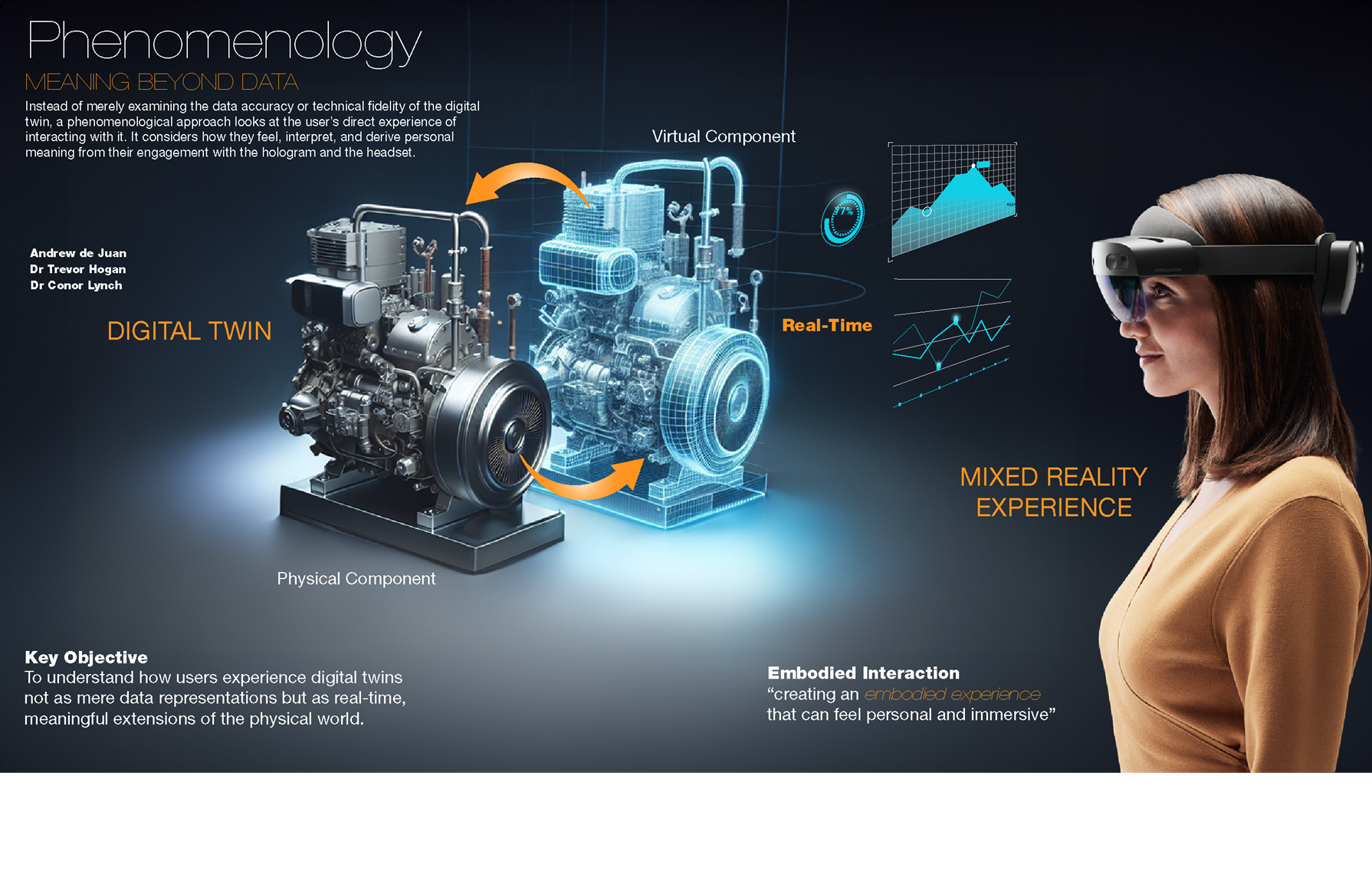
Phenomenology provides a deeply rich way of examining these experiences. Postphenomenology just doubles down, applying that depth specifically to technology. The humans’ relation to their world as mediated by technology. While there are certainly other valuable ways to study complex technological artifacts (MRDTs), the postphenomenological approach seems ripe for expansion, which I plan to explore in the next section.
In all seriousness, I need to write this bit up well in my research narrative in my full proposal.